

If you’ve logged into your ad platforms (e.g. Meta, Google Ads, etc) recently and noticed your CPCs quietly dropping, your first instinct was probably relief. Cheaper clicks should mean more efficient spend, right?
But then you looked at revenue.
It hasn’t moved the way it should have. Your conversion rate has slipped, and the ROAS you were expecting hasn’t shown up.
This isn’t exclusively a Meta problem. Across today’s paid media landscape, platforms are increasingly relying on machine learning and automated bidding to determine where ads appear, who sees them and how budgets are distributed. Meta, Google, TikTok and other major platforms are all built around the same fundamental premise: give the algorithm a business goal and enough data, and it will work to find users most likely to complete that goal.
The challenge is that the algorithm can only optimize toward the signals you give it.
If you’re optimizing for clicks, you’ll get people who are likely to click. If you’re optimizing for low-cost leads, you’ll get people who are likely to submit a form. If you’re optimizing toward purchases or qualified revenue, the platform has a much stronger signal for what a valuable customer actually looks like.
That’s why the real issue isn’t necessarily that CPCs are falling. It’s that lower-cost traffic doesn’t always equal higher-quality traffic.
The solution isn’t automatically spending less or abandoning a platform. It’s being more deliberate about where your budget is going, what signal you’re feeding the algorithm, how you’re measuring quality and what happens after the click.
Get those levers right, and inexpensive traffic can become an advantage instead of a liability.
Why Is This Happening?
Before jumping into fixes, it’s worth understanding what’s changing across paid media.
Algorithmic Expansion
Advertising platforms are increasingly automated.
On Meta, campaign delivery and placement decisions are heavily influenced by the platform’s machine learning system. On Google, Performance Max uses AI across bidding, budget optimization, audiences, creative and attribution to pursue the conversion goals advertisers provide.
TikTok similarly uses conversion events to optimize delivery toward users who are more likely to complete a desired action.
Automation can create enormous efficiency, but it also creates a new dependency: your platforms are only as good as the signals you give them.
More impressions and cheaper clicks can look like performance improvements in-platform while the quality of those visitors declines.
Market Competition and Bidding Shifts
Ad auctions are constantly changing.
Competitor budgets, seasonal demand, consumer behavior and changes in bidding strategies can all influence the cost of reaching a particular audience. A lower CPC may mean you are getting a genuinely more efficient opportunity—or it may mean the platform has found additional inventory that generates inexpensive clicks but fewer valuable actions.
That makes CPC an incomplete metric.
A $1 click that never becomes a customer isn’t necessarily better than a $4 click that generates a $200 sale.
Consumer Behavior and Measurement Gaps
The customer journey is also becoming more fragmented.
Someone might see a TikTok ad, search the company on Google, visit the website from an organic result, return through a Meta retargeting ad and eventually convert through a branded search.
At the same time, privacy changes, browser restrictions and signal loss make it more difficult for individual advertising platforms to see the entire customer journey.
The result is a measurement problem: each platform may have only part of the picture.
That makes first-party data, reliable conversion tracking and consistent attribution increasingly important.
Four Playbooks for Adapting to the New Paid Media Landscape
Playbook 1: Audit Traffic and Placement Quality
The problem: Cheap traffic can come from inventory that generates volume without generating meaningful intent.
The specific issue looks different on every platform.
On Meta, that could mean comparing Feed, Stories, Reels and Audience Network performance.
On Google, it means looking beyond aggregate campaign metrics and understanding where Performance Max and other automated campaigns are finding traffic. Google has expanded placement and search-term reporting for Performance Max, giving advertisers additional visibility into where and how campaigns are generating results.
On TikTok, it means evaluating whether high-volume engagement is translating into meaningful website actions and conversions.
What to do:
- Pull placement, search-term and audience-level reporting wherever the platform makes it available.
- Compare CPC against CVR, CPA, ROAS and downstream revenue, not CPC alone.
- Identify placements, audiences or search themes that consistently generate inexpensive traffic but poor conversion quality.
- Review performance by device, geography, creative and landing page when enough data is available.
- Don’t automatically cut inexpensive inventory. First determine whether the traffic is actually producing business value.
The goal isn’t to find the cheapest traffic. It’s to find the most valuable traffic at an efficient cost.
Playbook 2: Optimize Toward the Business Outcome, Not the Easiest Action
The problem: If your campaigns are optimized around upper-funnel or low-value signals, you’re teaching the platform to find people who are good at completing those actions—not necessarily people who become customers.
This applies across platforms.
Meta campaigns can optimize toward downstream events such as Purchase.
Google Smart Bidding can optimize toward conversions or conversion value, with strategies designed to maximize conversions, conversion value, Target CPA or Target ROAS.
TikTok supports standard conversion events such as Add Payment Info and Purchase that can be used for reporting, optimization and audience creation.
What to do:
- Identify the conversion that actually represents business value.
- Optimize campaigns toward purchases, qualified leads, booked appointments or another meaningful downstream action whenever volume allows.
- Assign accurate conversion values when possible.
- Avoid treating every form fill, page view or click as equally valuable.
- If you need to use micro-conversions because your account doesn’t have enough downstream volume, establish a clear path for eventually moving optimization closer to the final business outcome.
For lead-generation businesses, this distinction is particularly important. A $30 lead isn’t necessarily better than a $75 lead if the $75 lead becomes a customer twice as often.
Google specifically recommends using conversion actions such as qualified lead, converted lead, booked appointment or request for quote when lead quality is the objective.
The platform needs to understand what good looks like.
Playbook 3: Strengthen First-Party Data and Conversion Signals
The problem: Advertising platforms need reliable data to understand which users and behaviors are associated with valuable customers.
That’s becoming increasingly important as third-party signals become less dependable. Your own customer and website data can provide a much stronger source of truth.
On Meta, this may include Conversions API and first-party customer data.
On Google, advertisers can use tools such as Customer Match and enhanced conversion measurement to give Google’s systems better information about valuable customers and leads. Google specifically recommends first-party data and enhanced conversions for improving lead-quality optimization in Performance Max.
On TikTok, advertisers can connect website, app, offline and CRM data through Events API. TikTok recommends combining Events API with its Pixel for website measurement and optimization.
What to do:
- Audit your conversion tracking across every active advertising platform.
- Confirm that important downstream events are being captured consistently.
- Connect first-party customer data where appropriate and permitted.
- Use server-side conversion tools such as Meta CAPI, Google enhanced conversions and TikTok Events API where applicable.
- Connect advertising data with CRM and revenue data whenever possible.
- Evaluate not just how many conversions you’re generating, but which conversions eventually become customers.
Think of this as improving the algorithm’s vision. The clearer and more complete the data you feed your advertising platforms, the better equipped they are to distinguish between someone who is likely to click and someone who is likely to become a customer.
Playbook 4: Re-Evaluate the Post-Click Experience
The problem: Even perfectly targeted advertising can’t compensate for a poor landing-page experience.
If paid media platforms are reaching a broader mix of users, your website needs to work harder to turn that traffic into meaningful action.
What to do:
- Tighten the value proposition: Make sure your landing page immediately delivers on the promise made in the ad.
- Create message consistency: The headline, offer and call-to-action should make sense based on what the visitor just clicked.
- Optimize site performance: Slow-loading pages create unnecessary friction, particularly for mobile users.
- Reinforce trust: Use reviews, testimonials, guarantees, credentials and other relevant trust signals.
- Reduce unnecessary steps: Simplify forms and checkout processes wherever possible.
- Make the next action obvious: Don’t make users search for what to do next.
The advertising platform gets the visitor to your site. Your website has to finish the job.
A Real-World Fix: How Prospect Hub Addresses the Data Problem
Playbook 3 focuses on strengthening first-party signals, but what does that actually look like in practice? This is where a solution like Prospect Hub from V Digital Services comes in.
First, a Quick, Plain-Language Primer on First-Party Data
You’ve probably heard “first-party data” thrown around in marketing meetings, so here’s the simple version:
It’s information your business collects directly from your own customers and website visitors—things like email addresses, phone numbers and purchase history—rather than data you rent or buy from an outside source.
Think of it this way: If a stranger walks past your storefront and glances through the window, you don’t know much about them. But if they walk in, speak with your staff and eventually make a purchase, you now have a direct relationship and real information about who they are.
First-party data is the digital version of that relationship.
This matters because advertising platforms increasingly depend on reliable signals to identify valuable users.
Google’s Performance Max campaigns, for example, can use first-party customer lists and other audience signals to help guide its AI toward relevant audiences.
TikTok can similarly use customer and website data through its data connections to improve measurement, audience targeting and campaign optimization.
The principle is the same across platforms: Better data creates better signals. Better signals give algorithms a better chance of finding valuable customers.
What Prospect Hub Does, in Simple Terms
Here’s the problem most businesses run into: The vast majority of website visitors never fill out a form, log in or otherwise identify themselves. They browse, research, compare options and leave.
That creates a significant gap between website activity and known customer data.
Prospect Hub is designed to help businesses identify and enrich website visitors so businesses can better understand who is interacting with their website and create more actionable first-party data.
That information can then become part of a broader marketing strategy, helping businesses better understand their audiences and improve the signals they provide to their advertising platforms.
The core idea is straightforward: Better data in means better targeting out.
Why This Matters for the CPC/CVR Problem
Tie this back to where we started.
The problem isn’t simply that Meta, Google, TikTok or another advertising platform is producing cheap clicks. The bigger problem is when the platform cannot reliably distinguish between cheap traffic and valuable traffic.
Every major advertising platform is trying to make predictions:
- Who is likely to click?
- Who is likely to submit a form?
- Who is likely to purchase?
- Who is likely to become a high-value customer?
The quality of those predictions depends heavily on the quality of the information available to the platform. That’s why first-party data matters.
A solution like Prospect Hub can help address the gap between anonymous website activity and actionable customer information, giving businesses a stronger foundation for understanding their audiences and improving their paid media strategy.
In other words, if Playbook 3 is the “what”—strengthen your first-party signals—a solution like Prospect Hub is one potential answer to the “how.”
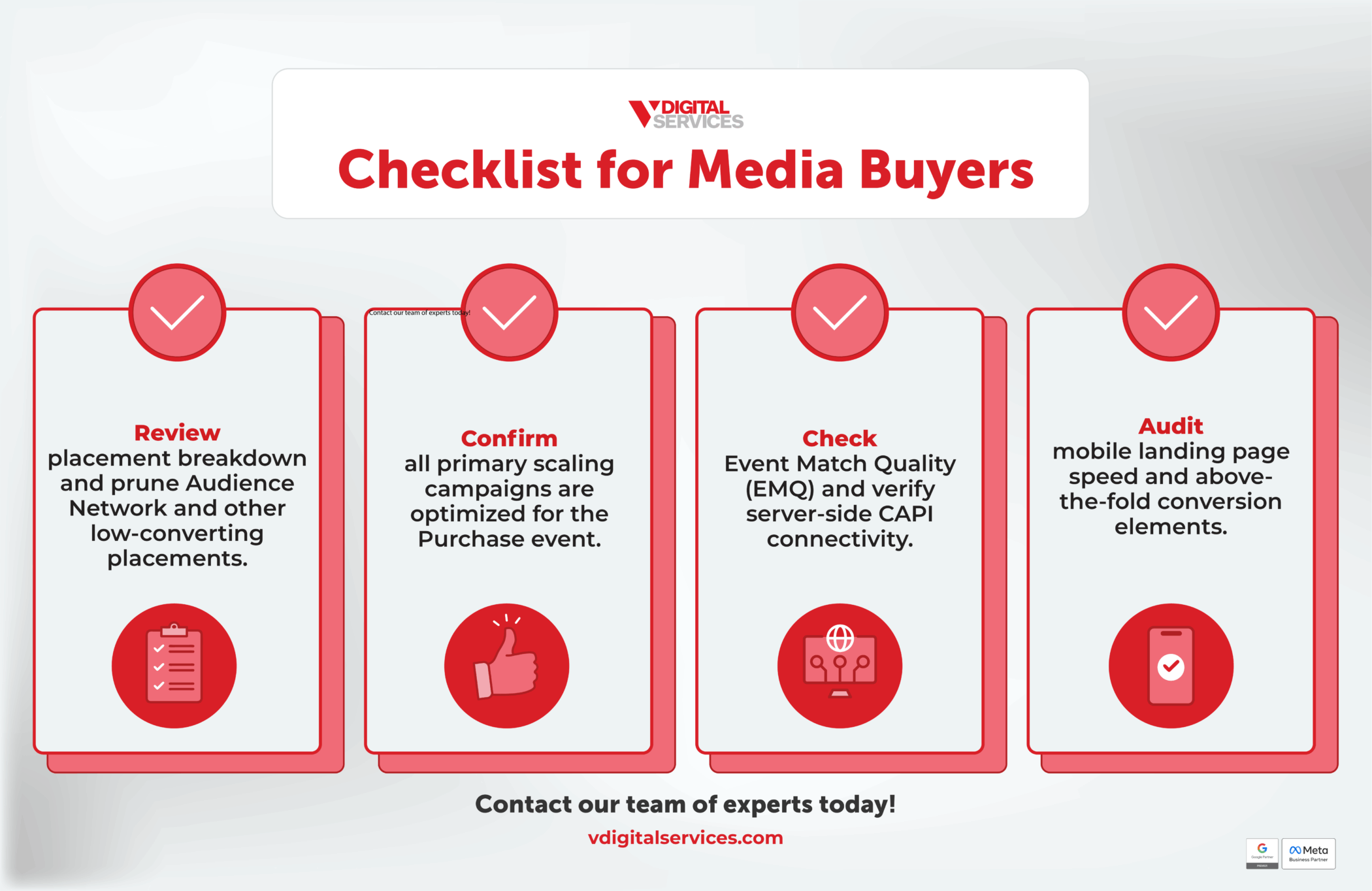
Summary Checklist for Paid Media Managers
- Review CPC alongside CVR, CPA, ROAS and revenue—not in isolation.
- Audit placement, search-term and audience performance across platforms.
- Identify inexpensive traffic that consistently produces poor-quality conversions.
- Confirm campaigns are optimized toward meaningful downstream actions.
- Review conversion values and lead-quality signals.
- Audit tracking across Meta, Google, TikTok and other active platforms.
- Verify first-party data integrations and server-side conversion signals where applicable.
- Connect advertising data to CRM and revenue data when possible.
- Review landing-page speed, messaging, trust signals and conversion friction.
- Evaluate performance based on business outcomes, not platform metrics alone.
Conclusion
Low CPCs are a double-edged sword. They can represent genuine efficiency, but without the right signal quality and a strong post-click experience, cheap traffic doesn’t necessarily translate into profitable traffic.
The advertisers navigating today’s paid media landscape successfully aren’t simply chasing the cheapest click available. They’re giving advertising platforms better data. They’re optimizing toward meaningful business outcomes. They’re evaluating traffic quality instead of volume alone. And they’re making sure every visitor who lands on their website has a clear path toward conversion.
Whether you’re advertising on Meta, Google, TikTok, LinkedIn or another platform, the fundamental principle is the same: Don’t optimize for the cheapest traffic. Optimize for the most valuable customer.
That’s the real difference between cheap clicks and profitable clicks—and increasingly, it’s within the advertiser’s control to close that gap.